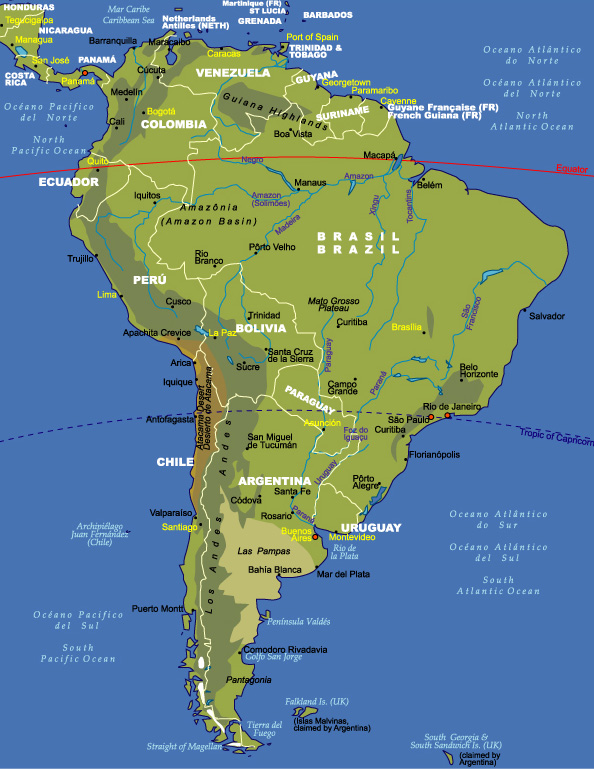
The itinerary details that we travelers received yesterday about our visit to Ecuador helped me feel really excited about the trip. I'm happy that the "scary" part of our trip (the visit to the jungle, where this city girl will
really miss electricity...) will come earlier, rather than later. Don't get me wrong; I'm very excited about this part of the trip, especially as I learned we'll be doing our school visit at a rural elementary school where my Spanish will come in handy. But I think having the most nerve-wracking part of the trip come toward the beginning of our stay will let me relax a bit and enjoy Otavalo, Quito, and the Galapagos much more. I am
pumped to visit the the
hot springs in Papallacta, the
Mercado de los Ponchos, the
Museo de Sitio Intinan, and
three of the Galapagos islands!
I must admit, I am overwhelmed about the amount of pre-travel planning required for this trip. Having never traveled further than Mexico, this experience will be unlike anything I have ever done before. There were so many things I did not even think to ask about, and so many interesting facts that I learned last night. I am fascinated to have learned that Ecuador uses American currency, and even more so that the dollar coin is the most popular denomination of money in circulation. The
list of medications we'll need to take/have prior to departure is pretty intense. At least I've got a strong stomach, so I won't have to worry about motion sickness on the bumpy roads... and I'll be visiting a travel clinic in early January, so I'll get all of the vaccines and medication I need then. One thing I do have to figure out myself is how I can possibly obtain all of the recommended clothing (wicking tops, zip pants, a hat with a brim, water shoes, etc.) and fit it all into a single, 44-pound suitcase. Yikes!
I have to be honest. At the beginning of
Galapagos: Born of Fire, I was pretty bored. I've never been interested in earth science, so hearing about how and when the Galapagos Islands were formed was the last thing I wanted to be doing after a long day. But as soon as the film shifted focus to the animals living in the Galapagos, I was riveted! The symbiosis between the sea lions and lizards, the dangerous cold-water swims undertaken by iguanas to access food, and the horrifying predation of the hawks on iguanas in an effort to feed their young all reminded me how much I love animals and appreciate biodiversity. One of the best experiences I had on my trip to Mexico in 2011 was swimming with manatees. I am really, really excited to observe and (I hope!) interact with animals on this trip to Ecuador and the Galapagos.
At the close of the night, we were asked to share one way to incorporate something we'd learned that evening into our classrooms. I felt flummoxed, unable to think of something creative. As an English teacher, I default to thinking about asking my students to do some reflective writing about their experiences with a particular topic, or reading a story set in a particular location. But later, at home, as I re-watched some segments of
Born of Fire on YouTube (seriously, I was VERY interested and wanted to share what I'd learned with my husband!), it occurred to me that I had heard two very interesting descriptions in the narration. First, as an iguana was chased underwater by a mischievous sea lion, narrator Tilda Swinton called it "nothing more than a one-sided game of cat and mouse." Later, she said that a giant tortoise being cleaned of parasites by a finch was engaging in a "slow-motion pit stop." These two metaphors show that elements of poetry can be found in the most unexpected places. They also helped me see the animals' behavior in a new light--which is exactly the purpose of a metaphor! I am excited to share these surprises with my students. I'm confident that this trip and my pre-travel education will provide a wealth of opportunities to incorporate science, nature, and culture into my ELA lessons.
Coin image: http://media.treehugger.com/assets/images/2011/10/US2520one2520dollar2520coin.jpg
Sea lion image: http://www.gypsynester.com/galapagos-sea-lion-4.jpg.